Caulking Services Sydney: The Small Job That Prevents Big Problems
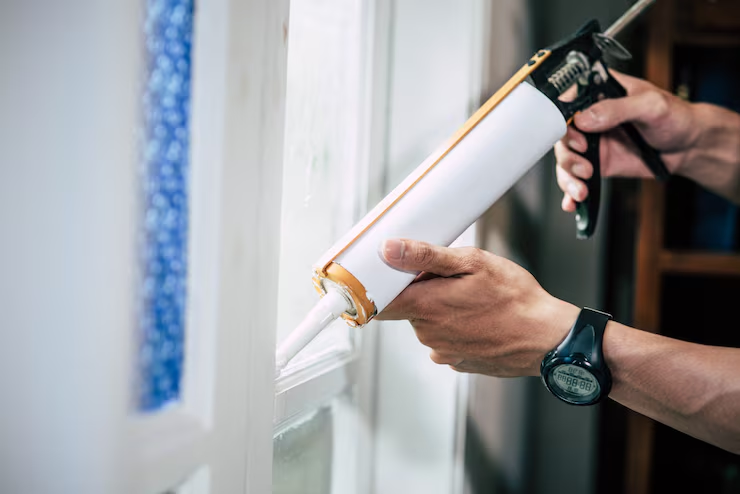
Here is a scenario that plays out in Sydney buildings every week. A homeowner notices a damp patch on the wall below a window. They assume it's a leak in the window frame or maybe a problem with the render. They call a builder. The builder investigates, finds water damage to the framing behind the wall, and quotes $8,000 to rectify. The original cause? A 30-centimetre gap in the caulking between the window frame and the wall, which had been letting water in for two years.
Caulking — the flexible sealant applied in the joints and gaps between building elements — is unglamorous, often invisible, and critically important. When it fails, as it inevitably does over time, water finds its way into places it has no business being. And water in a building is the beginning of a cascade of damage that gets more expensive the longer it continues.
What Caulking Does and Why It Matters
Buildings move. They expand and contract with temperature changes, settle on their foundations, flex under wind loads, and vibrate from traffic and foot movement. The gaps between building elements — windows and walls, facades and flashings, internal wall junctions — are designed to accommodate this movement.
Caulking fills these gaps with a flexible material that moves with the building while maintaining a continuous seal. Without caulking, or with failed caulking, these joints become pathways for water, air, insects, and noise.
In Sydney's climate, the consequences of failed caulking include water ingress leading to mould growth, timber rot, and structural damage; loss of airtightness leading to heat loss in winter and heat gain in summer; and noise transmission through what should be sealed gaps.
Types of Caulking Products
Walk into a hardware store in Sydney and you'll find dozens of caulking products. The key is matching the product to the application:
Silicone caulk: The most widely used product for wet areas and external applications. Excellent water resistance, good flexibility, long service life. Cannot be painted over (in most cases) — used where the finish appearance doesn't require painting. Available in a wide range of colours.
Acrylic caulk (paintable): Used for internal gaps where the caulk needs to be painted over — cornice junctions, skirting boards, internal window architraves. Not suitable for external use or prolonged water exposure. Paintable and sands smooth when cured.
Polyurethane sealant: Excellent adhesion, high elasticity, and paintable. Used for expansion joints, facade joints, and external window perimeters where significant movement is expected and a painted finish is required.
Fire-rated sealants: For penetrations through fire-rated walls and floors — around pipes, cables, and ducts. These are code-required in commercial buildings and their correct specification and application is critical for building compliance.
Acoustic sealants: Used to seal the perimeter of walls, floors, and ceilings in acoustically treated spaces. Maintains an airtight seal without introducing a rigid acoustic bridge.
Where Caulking Matters Most in Sydney Buildings
External window perimeters are the most critical caulking location on any Sydney building. Every window is a penetration in the building envelope, and the junction between the frame and the surrounding wall needs to be continuously sealed and flexible. Sydney's UV and temperature extremes degrade caulking relatively quickly — external window caulking typically needs inspection every 5–7 years and replacement when cracking or debonding is visible.
Facade penetrations — around pipes, electrical conduits, downpipes, and services that pass through external walls — need to be sealed carefully. Every penetration is a potential water entry point. During building repaints, these penetrations are a standard part of the caulking scope.
Internal wet area caulking — the joint between the shower screen and the wall, around the bath, at the base of kitchen splashbacks — is arguably the most maintenance-intensive caulking in any Sydney home. Silicone in these locations is subject to constant movement, moisture, cleaning chemicals, and temperature change. It typically needs replacing every 5–10 years.
Movement joints in masonry facades — the deliberately created gaps in rendered or masonry walls that allow sections to move independently — need to be filled with a highly flexible, backer-rod-supported sealant. If these joints are filled with rigid material (as sometimes happens during poorly done patch repairs), cracking results.
The Caulking Process Done Right
The quality of a caulking job depends almost entirely on preparation. Old caulk that's cracked, debonded, or contaminated with mould needs to be completely removed before new sealant is applied. New sealant applied over old contaminated sealant will fail quickly — it has no adhesion to the old product, and any movement transfers directly to the bond line.
Surfaces need to be clean, dry, and free from dust, grease, and old sealant residues. A primer is required for some substrates (particularly polyurethane sealants on certain surfaces). Backer rod (a compressible foam rod inserted into wider joints) is used to control the depth of sealant and ensure the correct geometry for the seal to flex properly.
The sealant is applied with a caulking gun and immediately tooled smooth with a wet finger or a caulking tool. This pushes the sealant into contact with both sides of the joint and creates the smooth, slightly concave profile that allows the joint to flex without cracking at the edges.
Caulking as Part of a Repainting Program
Most professional painting companies in Sydney include caulking as part of their repainting scope — and rightly so. Repainting an exterior or interior without addressing failed caulking is a waste of money. The paint will fail at the poorly sealed joints, and you'll have moisture problems continuing behind a fresh paint job.
When you get a painting quote, ask specifically what caulking is included. A quality painter will describe their approach to window perimeters, facade penetrations, and any areas where the existing caulking has failed. If a painter doesn't mention caulking at all, ask the question directly.
Need professional caulking services in Sydney?
We provide caulking as part of our painting and waterproofing programs and as a standalone service. Protect your building before small gaps become expensive problems. Call 0424 125 125 today.
Get a Caulking Service QuoteShare this article: